As U.S. Congressman Hakeem Jeffries is set to make history in January, all eyes will be on the likely first Black Speaker of the U.S. House of Representatives.
While there has been much public chatter about Jeffries being elevated to the powerful legislative role, more attention has been paid to the Brooklyn congressman’s record than to the position’s history and its role within the federal government.
The role of the Speaker is set out in federal law. Article I, Section 2 of the U.S. Constitution establishes that the House of Representatives shall choose its Speaker (“and other Officers”) who have the sole Power of Impeachment. The Constitution does not set qualifications for the role, such as age, citizenship, or membership in the House. However, every Speaker in history has been a sitting member of the House.
What the Constitution doesn’t establish is the Speaker’s current role as second in the presidential line of succession, following only the U.S. Vice President, meaning that, should the president and vice president be unable to serve, the Speaker of the House would assume the presidency. That rule was established by federal statute (codified at 3 U.S.C. § 19) in the Presidential Succession Act of 1947, after Harry S. Truman assumed the presidency in 1945 following the death of Franklin D. Roosevelt, serving without a vice president.
America’s first Speaker of the House was Frederick Augustus Muhlenberg of Pennsylvania in 1789. There have only been 56 Speakers of the House in 237 years, and while Jeffries would become the first Black American to join that list, he would also become only the third Speaker representing the state of New York—and the first since Reconstruction.
What are the duties of the Speaker?
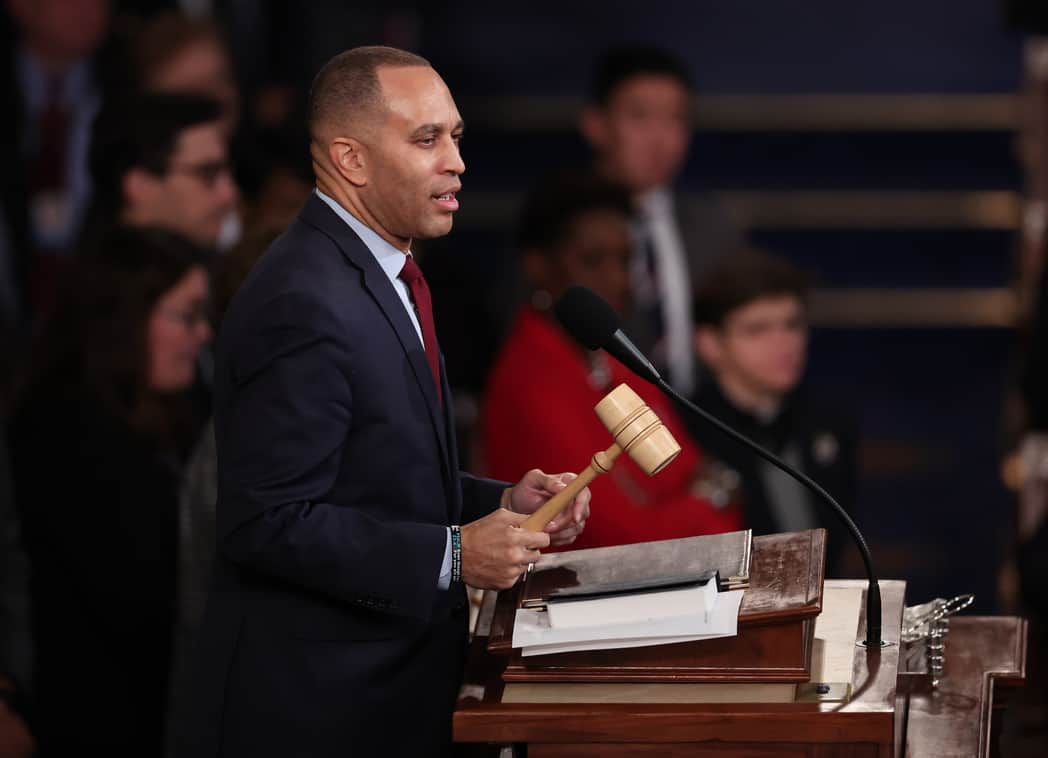


The Constitution doesn’t explicitly lay out any specific duties of the Speaker. Instead, the role’s function is based on precedent established by House rules and tradition developed over time.
The Speaker of the House serves as the presiding officer, the administrative head, and the majority-party leader of the U.S. House of Representatives. The most important function of the Speaker is deciding which bills reach the House floor for debate and votes and referring legislation to committees. The House Speaker decides which members may speak on the House floor and in what order. Additionally, the Speaker holds significant influence and direct appointment power over specific committees but does not unilaterally decide all committee assignments.
The ability to set the legislative agenda for the U.S. House is perhaps why Jeffries has faced such consternation from some Democrats who want to see the Democratic leader take bold, decisive action to pass progressive legislation like Medicare for All, abolishing ICE, revoking U.S. aid from Israel’s deadly military operations in Gaza, and H.R. 40, which would establish a commission to study the history and impact of U.S. slavery on Black Americans.
Jeffries has already committed to using the powerful position of Speaker to end President Donald Trump’s nearly year-long war in Iran and reverse cuts to Medicaid, Obamacare subsidies, and end Trump’s tariffs on foreign imports—all of which are driving the costs of health care, gas and oil, and other goods and services.
The Speaker of the House also plays a role in overseeing U.S. intelligence as a member of the “Gang of Eight,” comprised of members of Congress who are regularly briefed on classified intelligence matters by the executive branch. The Speaker also decides who serves on the House Permanent Select Committee on Intelligence (HPSCI), which oversees agencies such as the Central Intelligence Agency and the National Security Administration.
The power to impeach
The power to impeach is another important duty of Congress, as explicitly laid out by the Constitution. It is traditionally shepherded by the Speaker of the House. Impeachment is of particular importance to the incoming 120th Congress, which comprises several members who have already called for the impeachment of President Trump and members of his Cabinet for “high crimes and misdemeanors.”
While the Speaker does not have to file articles of impeachment, as that duty belongs to any member of the U.S. House, the Speaker—as an influential figure within the majority party caucus—can advance, block, or delay impeachment through procedural tools and majority support. Once articles of impeachment are passed by the House, the Speaker has the power and discretion to select House members to serve as impeachment managers, who are tasked with prosecuting the case against the president before it comes to a vote in the U.S. Senate.
Only three Speakers of the U.S. House have presided over the impeachment of a president: Schuyler Colfax of Indiana (Andrew Johnson in 1868), Newt Gingrich of Georgia (Bill Clinton in 1998), and Nancy Pelosi of California (Donald Trump in 2019 and 2021).
President Trump has repeatedly expressed concerns over being impeached for a third time, which would be a first in U.S. history. However, while Speaker-designate Hakeem Jeffries has expressed strong support for impeaching Defense Secretary Pete Hegseth, he has shied away from an outright call to impeach Trump without proper House investigations.
“As I’ve repeatedly indicated, we haven’t ruled anything in. We haven’t ruled anything out,” Jeffries told Politico. “We’re going to follow the facts. We’re going to apply the law. We’re going to be guided by the Constitution, and we’re going to let the chips fall where they may.”