In London’s famous Trafalgar Square now stands a monument to the everyday woman, and she happens to be Black.
“The Lady in Blue,” by American artist Tschabalala Self, was unveiled on Thursday, Sept. 10, and has, as the artist herself predicted, been garnering a “gamut” of reactions.
“People are allowed to develop their own relationship with it, and I encourage people to do so,” she said to media during the unveiling. “I also encourage people to be aware of my intentions with the work.”
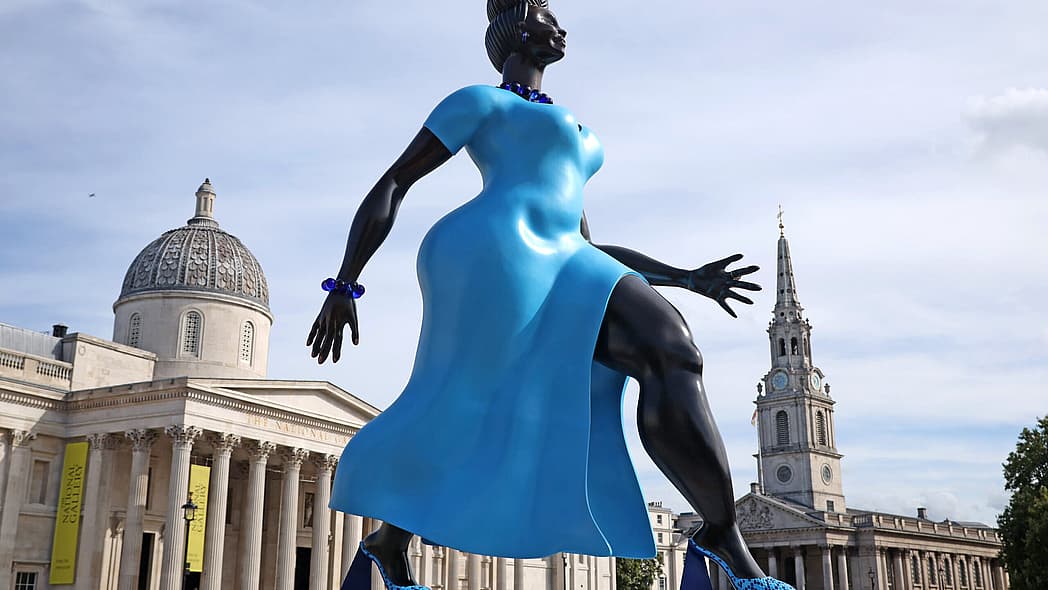
Commissioned by the Mayor of London’s Culture Team, Self’s largest public work to date stands 10 feet (or nearly 17 feet tall including the pedestal), more than 6 feet wide, and weighs nearly 7,050 pounds. Made of bronze, the ebony-colored, full-figured woman stands confidently in a turquoise dress with matching pumps and hoops, finished with a custom patina derived from the semi-precious stone lapis lazuli. Gazing out at the square, where she will remain for the next two years, “Lady in Blue” has been garnering critical acclaim while stoking old, familiar racist backlash at the thought of a Black woman on a pedestal.
Since its unveiling, the global art world has been lauding the statue. One reviewer writing for The Guardian, who called it a “masterpiece,” wrote, “Self has created one of the most beautiful sculptures put on Trafalgar Square’s empty plinth.” Meanwhile, The Times called it “A Joyful Sculpture with a Sashay.”




However, considering Britain’s rather extensive history with racism, colonialism, and the Trans-Atlantic slave trade, it’s no surprise the unveiling of a Black figure, a full-bodied figure at that, is eliciting a few harsher reactions from the general public. In addition to critics scrutinizing the statue’s race, some of the backlash has sparked a cultural debate about “who” represents the everyday Londoner, the tightness of her dress, the size of her proportions, and even claims that it could be “too woke.” The polarizing reactions are not unlike those of when the statue “Grounded in Stars,” also of a Black woman, was unveiled in New York in April 2025.
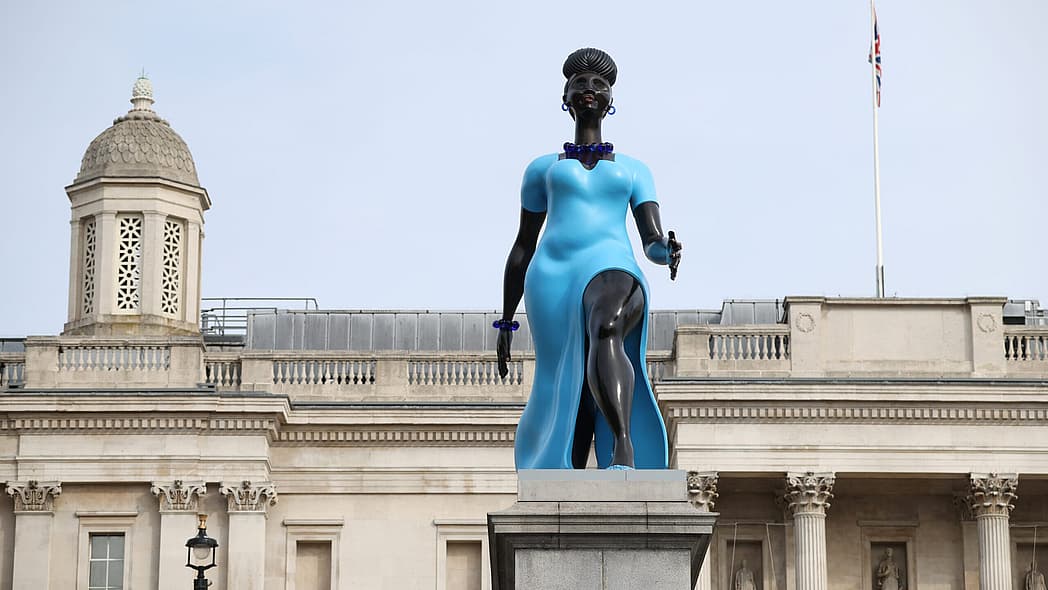
That discomfort is also part of what makes the statue so successful. For centuries, the public has been asked to gaze up at monuments to kings, military heroes, and other predominantly white historical figures, including plenty whose legacies include widespread violence and atrocities. For two years, Londoners are being asked to gaze up at an anonymous, fictional Black woman and consider her worthy of the same scale and elevation. If an ordinary Black woman can stand on the same pedestal once intended for a king, it’s implied then that perhaps anyone can.
Self, whose work is known for its vibrant colors, exaggerated proportions, and playful, often collage-like depictions of the Black female form, said she designed a contemporary Black woman who reflects the actual metropolitan demographic passing through London every day. She even designed her seemingly caught mid-stride, leaning forward with a sense of purpose. Because historical public art rarely highlights minority or everyday figures, Self said she wanted “Lady in Blue” to serve as an invitation for modern public audiences to look up, see themselves in the art, and realize their own agency and power.
Speaking to BBC, the artist said the figure in her statue is “a woman that many can relate to.”
“She is not an idol to venerate or a historic figurehead to commemorate,” she said, adding, “She is a woman walking forward into our collective future with ambition and purpose. She is a Londoner who represents the city’s spirit.”
The Fourth Plinth was originally built in 1841 to hold a permanent equestrian statue of King William IV, but after the funds ran out, the pedestal sat empty for over 150 years until, in 1998, a rolling initiative was launched to host temporary contemporary art commissions on it. To select the 2026 installation, an independent panel of curators, journalists, and artists, called the Fourth Plinth Commissioning Group, reviewed proposals from around the world. Self was announced as the winner in March 2024 and spent the subsequent 30-or-so months crafting the work.
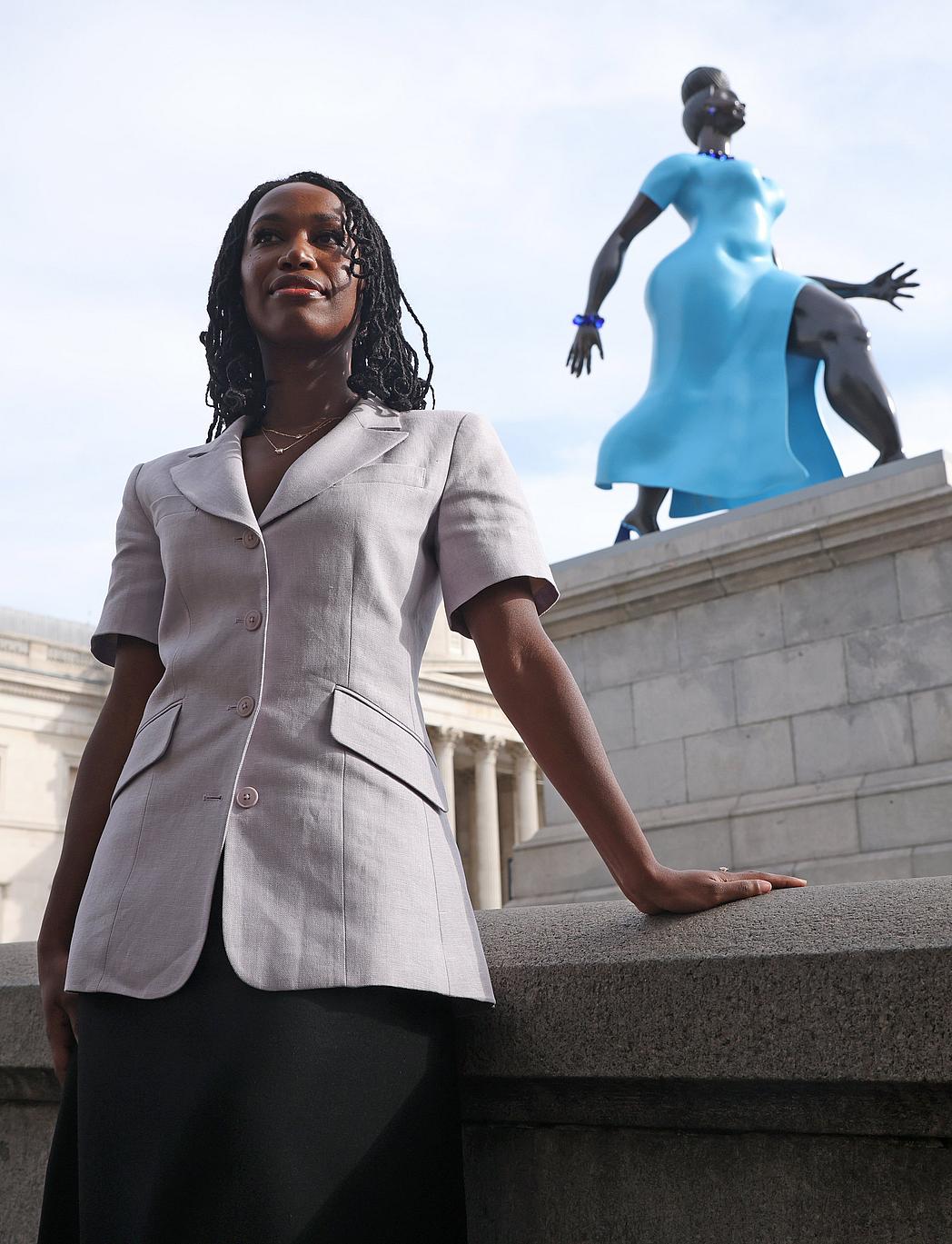
Unlike the traditional, solemn 19th-century war heroes and monarchs scattered across Trafalgar Square, she wanted to make a monument to an anonymous, ordinary person.
Self, who hails from Harlem, New York, and whose work has been exhibited worldwide, including in the permanent collections of the Whitney, MoMA, and the Art Institute of Chicago, has become known for her multidisciplinary, multidimensional work. Using an innovative hybrid style that blends painting, printmaking, and sewn textile collage, she creates powerful figures designed to challenge historical stereotypes and celebrate modern Black identity.
With that resume, it’s little wonder that she said no reaction would really catch her off guard. She was, in fact, anticipating the discourse.
Speaking to The Guardian ahead of the unveiling, Self said, “I’m ready for a whole gamut of reactions. I’m not nervous – I think everyone is entitled to their own opinion of the sculpture. Each will shed light on to some facet of the reality we’re all currently living.”